Álvaro Gómez
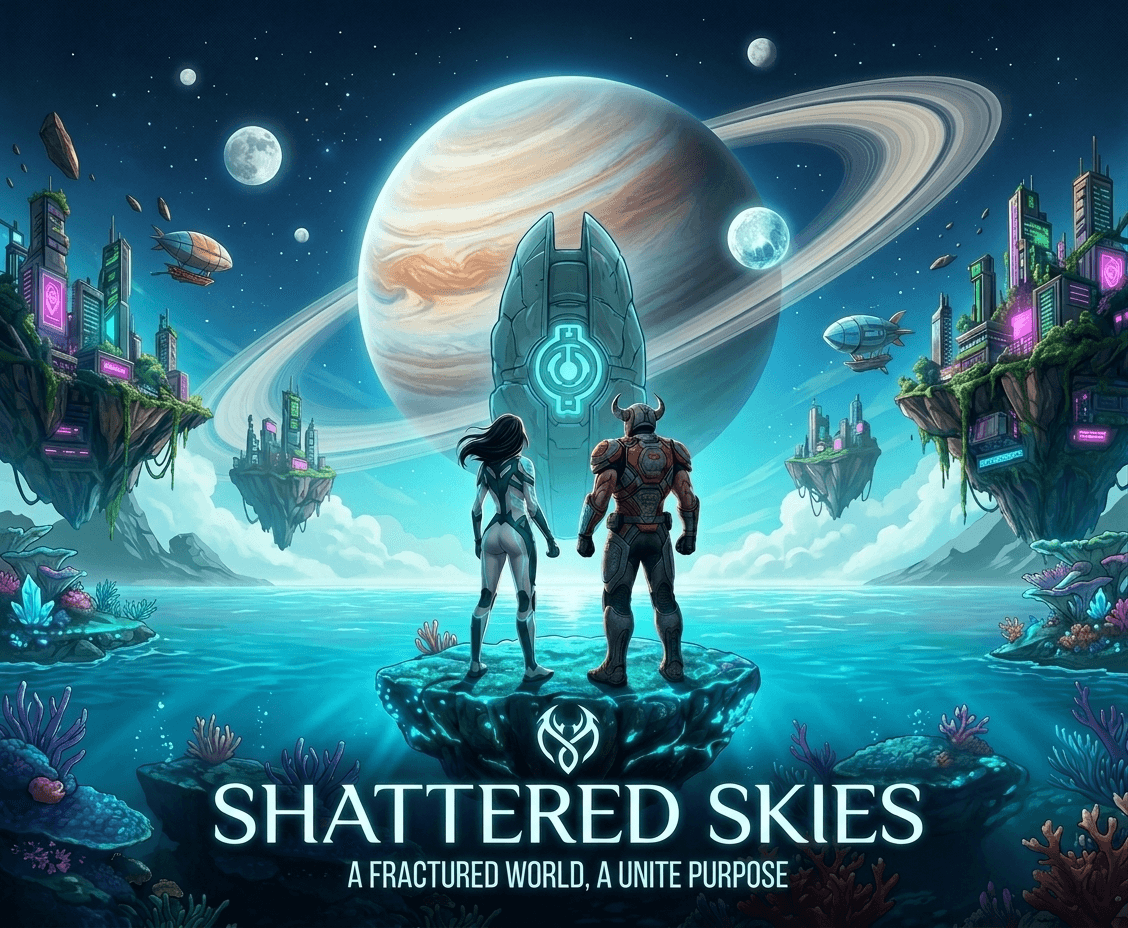
Shattered Skies key art placeholder

UNITY · TEAM OF 5 · 2025

Shattered Skies

A fractured world with a united purpose. Two enemies, one life they must preserve.

EngineUnity
RoleGame Designer
TeamTeam of 5
Year2025

Overview

The Vision

Shattered Skies entwines two soldiers from enemy species that hold the same parasite, The Symbiochord. These two characters do not share the same language, making communication difficult. The action takes place in a dangerous and dynamic planetary system forcing them to cooperate to survive and decide whether to trust the person they were raised to hate. I mainly designed the world they move through and the systems that force them to stay together. Planets and their physics, interdependent puzzles, the traversal mechanics and their power-ups and the progression based in the learning and understanding of the universe.

Gameplay Videos

The Gameplay

The Main MenuThe first thing the player sees: The Spaceship
The spaceship in the gameThis is the main traversal mechanics between the planets, carrying real in-game mass
First LevelThe first level, an interior level. The resources are spread around the level and they are protected by enemies.

The game we worked on

The Game

This two-player narrative exploration adventure is set in a solar system. Two members of enemy species are infected by the Symbiochord. Their names: Drayk, a Rynor soldier, and Aevi, a Tethran scientist. This parasite connects their bodies and their fate. If one dies, the other dies too. They have to cooperate although their species have been at war for centuries.

  • Rynor · Soldier

    Drayk

  • Tethran · Scientist

    Aevi

Narrative structure

Narrative structure of Shattered Skies: two backstories, five story beats and three endingsTwo backstory nodes, Drayk of the Rynor and Aevi of the Tethrans, converge where the Symbiochord chains them together. From there a single spine runs through four story beats — forced cooperation, a closing removal window, doubt sown by the Veynar ruins, and escalating suspicion — and drops into the fifth beat, the final choice. Below it each player seals one decision, with no information passing between them, and every ending takes one line from each of them, because it is the pair of choices that decides which of the three is reached: Unity if both choose selflessly, Betrayal if one of them chooses selfishly, and Mutual Destruction if neither cooperates.THE BACKSTORIESTHE CHOICETHE ENDINGSBACKSTORYDRAYKRYNORBACKSTORYAEVITETHRANONE LIFESYMBIOCHORD1ST BEATFORCEDCOOPERATION2ND BEATLIMITED TIME3RD BEATDOUBT &MISUNDERSTANDING4TH BEATTENSIONSESCALATE5TH BEATTHE FINAL CHOICEMOMENT OF TRUTHSEALEDDRAYK CHOOSESSEALEDAEVI CHOOSESNO INFORMATIONBETWEEN THEMTHE PLAYERS DECIDE THE ENDINGUNITYBOTH SELFLESSBETRAYALONE SELFISHMUTUAL DESTRUCTIONBOTH SELFISH

Scroll the map sideways to follow it →

The map carries the shape and the names. Each beat, each ending and how the two sealed choices pick between them are written out in full on the deep dive.

The map is drawn on wider screens. The same structure reads top to bottom here: the two hosts above, then the five beats in order.

  1. 1st Beat

    Forces Cooperation

  2. 2nd Beat

    Limited Time

  3. 3rd Beat

    Doubt & Misunderstanding

  4. 4th Beat

    Tensions Escalate

  5. 5th Beat

    The Final Choice & The Moment of Truth

The narrative structureThe narrative structure that all designers had access to in the GDD. The beats, the character backstories and the three endings possibilities.
The planets in gameThe planet layout in-game. The planets are placeholder textures due to lack of time, but the system works for adding the new 3D models. The design of the five planets is below.

My Role

My Contribution

The planetary system & the world design

Researched real gravity, orbit and tide behaviour for the five worlds, so the physics are as natural and easier to learn for the players.

Interdependent puzzle design

Designed the interdependency of the puzzles, requiring cooperation, simultaneous action and timing within the gameplay's asymmetry.

Traversal & asymmetry mechanics

All movement design: the two bodies with opposite strengths, jetpacks sensitive to weight and the shared fuel supply, and their own cooperative mechanics like the boost.

Progression based on knowledge

Inspired by metroidvania's world comprehension instead of systems upgrades. Players need to understand the world for powering-up and progressing.

World and the five planets

The World and Planet Design

The Shatterstorm

The main event of the game is a metaphor of the relationship of the characters. This event broke the world into pieces that stay together. The same as Aevi and Drayk.

Designing this setting was an important world design decision. The environment of the world has the same patterns as their characters. Broken by war, but fully connected.

Design Challenge

The main challenge as a designer in the level and world design was to make a planetary system that functions as a puzzle, at the same time that it had to be as realistic as possible. The realistic approach made the learning easier for the players when it comes to recognising the same patterns in physics in the game and in the real world. The main decision that connects all of these decisions together is the moon Tidalor, since its path opens when the orbit pulls the tides low. Another example is Dunestorm, whose gravity locks players until they learn how to upgrade their jetpacks. That's how progression becomes knowledge advancing through systems observation.

EngineUnity
SystemWorld design / physics / progression
ResolutionMake physics realistic for a better pattern recognition and progression based on knowledge.

The Planetary System in Movement

InteractableChoose any world and its survey entry opens below and the other four dim.Click, tap, or press Tab to reach it and then Enter.

No world selected.

The Planetary System Dossier

Worlds
5
Habitable
1 — Remnara
Range
1,570 °C → −34 °C

Access

How the solar system works

All the levels are accessible from the beginning, however, to get to some places players need to understand how the system moves.

There are no keys or hidden traversal upgrades in Shattered Skies. What limits the players' movement is based on how the world functions: the orbits of the planets, how they align and how the environment works. This is the key for progression.

Orbit HintA star at the centre with one orbit drawn around it. A planet sits on one side of the orbit and the location it must align with sits directly opposite, with a dashed line running between them straight through the star. The caption marks that line as the moment the cave is open; at every other point on the arc it is shut.Anywhere else · shutAligned · open
What this looks like in gameplayThere are notes in the world hinting the player how to progress, helping them progress. One of them describes a cave that can be entered while the planet's orbit is in a particular rotation. The cave is closed most of the time, but during that time in particular, the door is open.

This progression cannot be lost, given or skipped. The players unlock the world by understanding it.Carrying this information is crucial for other sessions.

  • Openeasy access
  • Orbital windowroute opens as the planet orbits
  • Gravityadapt to surface
  1. Planet 1

    Pyroterra

    Lava World

    Gravity
    2.7 m/s²
    Class
    Low
    Diameter
    4,500 km
    Temp
    1,570 °C

    AccessOpen

    This is where the game begins

    What you have to knowNo knowledge required.

  2. Planet 2

    Dunestorm

    Desert World

    Gravity
    17.01 m/s²
    Class
    High
    Diameter
    9,645 km
    Temp
    61 °C

    AccessSurface gravity

    The high gravity makes it easy to access but difficult to leave.

    What you have to knowThat the spaceship can be upgraded to leave.

  3. Planet 3

    Remnara

    Temperate World

    Gravity
    9.1 m/s²
    Class
    Earth-like
    Diameter
    5,580 km
    Temp
    18 °C

    AccessOpen

    Both characters are comfortable in this planet. Easy to navigate.

    What you have to knowNo knowledge required.

  4. Moon

    Tidalor

    Ocean MoonMoon of a gas giant

    Gravity
    1.03 m/s²
    Class
    Low
    Diameter
    2,100 km
    Temp
    7 °C

    AccessTidal window

    Routes open and close with the tides, thanks to gravity. The same path is a corridor at low water and gone at high.

    What you have to knowWhich part of the arc runs the tide low.

  5. Planet 5

    Cryonix

    Dwarf Planet · Ice

    Gravity
    0.51 m/s²
    Class
    Extremely low
    Diameter
    1,150 km
    Temp
    −34 °C

    AccessOpen

    Nothing is locked, which is what makes it mysterious.

    What you have to knowThe Zyrium under the ice as it is the known way to remove the parasite. At least one player needs to understand this.

HottestColdest

Each planet shows a skill

Level Design

Each planet teaches a different skill and challenges the players. The last planet is the ultimate challenge, since it combines everything the players learn through the whole journey.

The play order and each skill.

InteractableChoose any world and its full design sheet and score notes open below the rail.Click, tap, or press Tab to reach it and then Enter.

Planetary level design chart. Rows are design dimensions, columns are the five worlds in play order. The audio row is designed entirely by me; the level design rows were co-designed with one other designer.
TeachesThe Core mechanics: puzzle-solving, platforming, resource gatheringNavigation and decryption. Adapt to a dynamic terrainUnderwater traversal. Oxygen and resource managementAdvanced puzzles. Use of light refraction and unstable traversalStealth and combat ultimate challenge
SignatureRedirect lava to unlock vaultsSolve ancient symbols to decrypt secretsJetpack traversal underwater. Recovering relics cooperativelyRefract light through crystals to open the cryo-chambersGather resources protected by hostile animals
UnlocksFire-resistant shields, stamina boosts, energy crystalsDust repellers, old inscriptions, upgrade resourcesOxygen harvesters · jetpack upgradesCrystal augmenters · heat-resistant gearCamouflage clothes, high-value resources, lore items
HazardsDynamic lava flows, crumbling platformsSandstorms, dunes, buried traps in the sandOxygen management, aquatic predators, currents and water pressureSlippery surfaces, collapsing ice, blizzardsAggressive wildlife and toxic flora
VisualsIntense red colours, lava rivers, grey skiesGolden dunes, weathered ruins, miragesBioluminescent underwater, ruins, and pitch black for the depthsLight blues, reflections and glittering cavesVibrant greens, towering trees.
AudioFast and aggressive. A choir that carries the melodyHeavy and ambient. Strings as leading instrumentsA calm 3/4 tempo. Tides in the soundtrackMinimalist. Instruments use harmonicsCalm, melodic, familiar, sounds like home
  • Planet 1 · Lava World

    Pyroterra

    Teaches
    The Core mechanics: puzzle-solving, platforming, resource gathering
    Signature
    Redirect lava to unlock vaults
    Unlocks
    Fire-resistant shields, stamina boosts, energy crystals
    Hazards
    Dynamic lava flows, crumbling platforms
    Visuals
    Intense red colours, lava rivers, grey skies
    Audio
    Fast and aggressive. A choir that carries the melody
  • Planet 2 · Desert World

    Dunestorm

    Teaches
    Navigation and decryption. Adapt to a dynamic terrain
    Signature
    Solve ancient symbols to decrypt secrets
    Unlocks
    Dust repellers, old inscriptions, upgrade resources
    Hazards
    Sandstorms, dunes, buried traps in the sand
    Visuals
    Golden dunes, weathered ruins, mirages
    Audio
    Heavy and ambient. Strings as leading instruments
  • Moon · Ocean Moon

    Tidalor

    Teaches
    Underwater traversal. Oxygen and resource management
    Signature
    Jetpack traversal underwater. Recovering relics cooperatively
    Unlocks
    Oxygen harvesters · jetpack upgrades
    Hazards
    Oxygen management, aquatic predators, currents and water pressure
    Visuals
    Bioluminescent underwater, ruins, and pitch black for the depths
    Audio
    A calm 3/4 tempo. Tides in the soundtrack
  • Planet 3 · Dwarf Planet · Ice

    Cryonix

    Teaches
    Advanced puzzles. Use of light refraction and unstable traversal
    Signature
    Refract light through crystals to open the cryo-chambers
    Unlocks
    Crystal augmenters · heat-resistant gear
    Hazards
    Slippery surfaces, collapsing ice, blizzards
    Visuals
    Light blues, reflections and glittering caves
    Audio
    Minimalist. Instruments use harmonics
  • Planet 5 · Temperate World

    Remnara

    Teaches
    Stealth and combat ultimate challenge
    Signature
    Gather resources protected by hostile animals
    Unlocks
    Camouflage clothes, high-value resources, lore items
    Hazards
    Aggressive wildlife and toxic flora
    Visuals
    Vibrant greens, towering trees.
    Audio
    Calm, melodic, familiar, sounds like home

Planet 1 · Lava World

Pyroterra

Teaches: Core mechanics

Forces the players to learn quick to survive. The environment tries to kill constantly, through lava rivers and eruptions, but these are dodgeable since they come in patterns. The audio sets the tone: human lines in a world in which nothing human is left.

What it teaches
Teaches
The alphabet: solve, platform, gather.The first world that teaches three core mechanics: how the puzzles work, how the jumps are timed and why resources are important. These are repeated throughout the game.
Signature
Lava redirection. The lava rivers that kill the player are used to open the vaults to progress. This is for the player to understand that anything can be a tool and that the world can interact with itself.
Tools & threats
Unlocks
Fire-resistant shieldsOpens paths for running straight through the heat.RewardsStamina boosts and energy crystals.
Hazards
  • Dynamic lava flows
  • Fragile platforms
  • Erupting vents
Look & soundAudio design credit: Fully Mine
Visuals
Intense red and orange predominant in the world, magma rivers cutting through black rock, grey skies with eruptions going off on the horizon. So it's clear that the environment is dangerous.
Audio
Fast-paced and aggressiveChoir voices for the main melody.

Audio designAudio design credit: Fully Mine

Two main audio decisions

Between worlds · the ship

Minimalist ship music

The ship's music is almost non-existent. It has a chorus whose contrast is the point: two people in a ship against a system that does not notice them.

The teaching progression: what it teaches · what you hear · what it demands.
  1. Core mechanicsPyroterralava · choir · timing
  2. Navigation & decryptionDunestormsand · strings · getting lost
  3. Traversal & resource managementTidalorbioluminescence · a waltz · running out of air
  4. Advanced puzzlesCryonixrefracted light · harmonics · thin ice
  5. Stealth & combatRemnaragreen ruins · a familiar melody · things that hunt

Core Mechanics

Mechanics Design

These systems were designed with the team. The purpose of them was to make the players cooperate and rely on each other without any kind of communication.

The throughline

The two characters belong to two different species. They don't share language, so when we built these systems we had to consider this barrier and the way cooperation should work without communication. So the players could feel comfortable with the system we decided to enhance this cooperation by having it through the whole game, like in the ship and the jetpack boost.

The design reasoning was more centred on “how do we make trust cost something”. Then the system had to be around not having a voice chat and design problems they can solve without them.

1The Main Mechanic

Characters with a Different Language

Drayk and Aevi do not share the same language and we had to make that miscommunication exist within the game.

We tried to twist how co-op games are usually designed, because they have a channel and build trust through it. However, we were taking that away, so we had to design some other kind of communication channel.

  1. Distorted voice chat

    Unity Voice Channel Distortion plugin

    Voice chat is run through a distortion plugin in Unity. The only thing that players can receive is the tone, but not the words.

    Decision
    It breaks the voice channel and it is present since the beginning of the game.
    Why
    These two characters cannot understand each other. If the voice chat was completely removed the experience would have been less genuine, but we wanted to create the sensation that the characters are able to communicate but they simply cannot understand each other at all. Adding the distortion just keeps the character audible but without any meaning, adding up to the kind of story we were trying to tell. This also protects the dual narrative, as it gives the players different stories that they cannot share through any channel.
    Player impact
    We noticed that the players focused on playing and not on talking. Voice could have a specific tone but does not have any meaning at all. This builds-up mistrust or the opposite when reading the others behaviour.
  2. A rule outside the game

    Players have to agree not to talk during the game. This restriction has to exists outside the game to keep the intention of the whole design.

    Decision
    For experiencing the game as it was designed, we asked the players to not talk outside of the sessions.
    Why
    The game design decisions were focused on miscommunication and this is also part of the story. We expect the players to respect these rules. Shattered Skies could have had a voice chat like most co-op game do, but the ambiguity is what this game was built from and every decision was taken towards that direction. Players can break it, but they will not experience the game properly.
    Player impact
    Players become part of the barrier the games require. This is the first cooperative mechanic. Eventually, this could grow in them as suspicion or trust.
  3. Gestures get lost in translation

    Some render differently per player

    Simple gestures, but some render differently to each player, so even body language is lost in translation.

    Decision
    This gives the player a non-verbal expression, but for each character means different things.
    Why
    We thought that different cultures could have different meaning for each gesture, this could be part of the miscommunication system. This doesn't work in all gestures since sometimes players need to know the minimum to understand each other.
    Player impact
    Players ended up sharing a gesture language for themselves and communicating without talking. Through trial and error they were able to relate actions to gestures.
  4. Telepathy window

    5 seconds with the voice filter off

    This resource grants five seconds with the filter off and voice chat perfectly clear. It is a rare one. It is not too long for building a proper phrase, but gives the opportunity to communicate through a voice. Players can use this for lying too. Linking this to the Mutual Destruction ending.

    Decision
    We wanted to give the players at least one chance to talk with each other before the ending and even relate to it.
    Why
    If talking is constant, it stops being a design decision that was set at the tutorial. This unique opportunity turns it into a great decision for the players: what is worth saying? Connecting it to the ending is what makes it an interesting mechanic since they can also lie to each other, which was impossible during the game.
    Player impact
    These five seconds of communication becomes a prisoner's dilemma. Players used this window for warning, planning, confession or lying, getting to the ending they wanted.

How the Telepathy Works

Here is a graph explaining the mechanic

How the Telepathy WorksA flow in three columns. On the left, the telepathy window: five seconds of clear speech, granted by a rare resource. In the middle, the choice each player makes inside it — speak true or speak false. On the right, the three endings those choices feed: both true leads toward Unity, one lie toward Betrayal, and two lies toward Mutual Destruction.The resourceplayers decideEndingsThe telepathy window5 seconds · filter offSpeak trueSpeak falseUnityBoth spoke trueBetrayalOne of the two liedMutual DestructionBoth spoke false

Scroll the flow sideways to follow it →

This window does not pick the ending by itself, only the final decision does. This moment can be used to express what players know and believe or the complete opposite.

The reason behind this was to let the players decide a single moment of communication. However, every single mechanic embraces the miscommunication, while the telepathy permits what players have been missing the whole game.

2Cooperative move

The Spaceship

The home base. Players will have to learn how to use it to navigate through the planetary system.

Reference · Combined driving

The reference we took as a team and what we wanted from it. We wanted the players to cooperate in a ship where the controls were physically distributed. This helped to understand cooperation without communication.

The ship is the way players navigate through planets, but it is also the main hub and their safe place. To control it, it takes both of them, as steering, shields, cannons and radars are in separate rooms, making the players to physically move and coordinate: one is steering while the other one turns on the shields. We gave the ship realistic weight and inertia, making the navigation difficult even through communication.

The main ship systems

Steering
Heading and thrust. Weight and inertia are real, forcing turns to begin early.
Shields
Directional cover. To hold one arc makes another one open.
Cannons
Clears asteroids and hostiles, can be aimed independently of where the ship points to.
Radar
Reads hazards, space trash and celestial bodies.

Repair

The asteroids and space hazards can damage the ship, which then has to be repaired. The repair becomes a minigame, so players can still navigate.

In depthThere are three minigames: Power Maze, Seal the Breach and calibrate sensors (Navigation). Each one divides the knowledge and control between the two players. Click here for how the three mini-games work

Decision
The functions of the spaceship are distributed and it has real mass, so it cannot be fixed instantly.
Why
Both players have to cooperate even in the most basic movement. Spreading the functions makes the navigation a kind of communication.
Player impact
Players ended up auto-organising in roles and then when the ship got damaged, they would change them. This kind of cooperation to one of the most important mechanics helped them in future puzzles.

Design pointWe were trying to make cooperation as mechanical and intuitive as possible in the spaceship. Helpful for future puzzles and forcing it in the most important mechanic.

03Movement

Sharing a Fuel Tank

The characters move asymmetrically, but they share the same tank that makes their jetpacks function.

Both characters have different traversal mechanics. Aevi is small, quick and doesn't jump far. Drayk is big, slow and jumps high. Both their bodies show how their moves work and how they could help each other. Many puzzles are designed around this: one reaches a ledge and the other one helps to reach it. This makes both characters well-balanced.

  • Aevi

    Small · quick · short jump

    Runs fast and can fit where Drayk can't, but needs him for jumping far. The jetpack takes her higher due to her light weight and consumes less fuel. This makes her strong when the players need to be quick.

  • Drayk

    Large · slow · long jump

    Can reach through jumping where Aevi cannot, however, he burns the fuel faster than her when using a jetpack, but very useful when strength is required.

Jetpacks

Both have access to a jetpack from the very beginning, permitting this move from the start. They are limited by fuel and they are sensitive to the character's weight. Aevi being lighter than Drayk and balancing the jumping mechanics. They are also used in some puzzles.

The thruster as an environmental verb

  • Underwater

    The packs work submerged, which is how a drowning player reaches the next air pocket.

  • Melting ice

    Thrust held against a frozen wall opens a path that was solid a moment ago.

  • Burning growth

    Wood and overgrown plant matter burn away, clearing routes the world had closed.

The collision booster

When both players jetpack into each other while in use, they create a booster to move them higher. Fuel drains fast while this happens, so the movement has to be intentional at every point.

Decision
Make the highest point in the traversal kit reachable only by two players colliding on purpose, and let them transfer fuel to each other.
Why
Asymmetry alone produces turn-taking — you lift me here, I squeeze through there — which is cooperation but not trust. The booster needs both players to commit at the same instant, spending a resource they can watch running out, for a partner they cannot talk to. Sharable fuel then makes generosity an actual mechanic with an actual cost.
Player impact
The best traversal in the game is also the most exposed thing a player can do. Getting it right is the pair's clearest evidence that they have learned to read each other; getting it wrong strands them, and stranding is the game's quietest punishment, because nobody can explain whose fault it was.
The communication channel in-gameThe Conversation Panel, bottom right, in the HUD next to the objective and the weapon slot.

Division, Distortion and Improvisation

The Cooperative Design

How the main mechanics work. How each player interacts with the minigame and the way they were designed to enhance cooperation.

The main design

The minigames in the ship are always divided into two. Knowledge and control, giving one to each player, and expecting them to collaborate without talking with each other.

  1. Division

    One player is given the whole picture of the puzzle, while the other has to interact with it.

  2. Distortion

    While this happens, the voice channel is being distorted so the instructions feel like noise.

  3. Improvisation

    The pair will have to make up their own signals and use common sense to complete the minigames.

The puzzles are not a skill test, they are a communication test. The difficulty comes from the lack of conversation that they could have. The way they communicate is completely up to the players and the way they have to express ideas. The time they take to solve them depends fully on them.

The Puzzle Structure

Puzzles cannot be solved by players individually. The way they were designed follow these ways:

The loop

  1. An area only one character can get to

    There is an object, whether it is a lever, a socket or a console, and a gap that can only be jumped by one of the characters. The solution is whoever can jump that far.

  2. One interacts, to let the other pass

    The player that can reach the object cannot solve it. The solution relies on the other player's movement when the first triggers a bridge or a platform.

  3. The Symbiochord limiting the distance

    The parasite lets the characters distance from each other in a limited way. If they are too far apart, they die. Some puzzles' solutions put this into risk and positioning is key.

  4. Holding the object exposes you

    Interacting usually means vulnerability while this is happening. The players have to decide how long this goes on so the players don't die.

  5. Shared solution

    Puzzles require both to be solved. If one of them dies while solving it, they both do.

Why the Symbiochord is in the puzzle design at all

Connects the mechanics to the narrative directly. This way players stop thinking just about how to solve a puzzle by themselves, and think as a team that cannot separate. This also wires them together in a way that they know, all the time, that they cannot survive without the other.

These are the elements that make the puzzle design. Players will have to consider every aspect of this to solve them.

1The core puzzles

The Ship Repairs

When the ship is damaged, it has to be repaired through the same pattern: the problem is divided, each player gets one half and the voice chat distortion between them.

Asteroid fields and the hazards between worlds do real damage, and damage has to be repaired by hand, mid-flight, while the ship is still being flown. The three minigames below are the same design argument told three times — first with the knowledge split, then with the control split, then with both at once. Each one ends the same way, too: not with a player getting better at the puzzle, but with two players getting better at each other.

InteractableChoose any seat and the diagram drops to just that seat's half, and the other goes dark.Click, tap, or press Tab to reach it and then Enter.

  1. Circuit Realignment

    Power · 8x8 grid maze · knowledge division

    A dead system comes back on line when its power node is walked across an eight-by-eight grid and reconnected to the source. The grid is a maze — walls between cells, one route through — and the node moves one cell at a time.

    Puzzle Sample
    Puzzle SampleTwo panels side by side, joined at the top by a broken arc labelled “distorted voice”. On the left, the blind player's screen: an empty eight-by-eight lattice with the power node on it and directional ticks around the node — no walls and no source. On the right, the guide's screen: the same eight-by-eight grid with every wall drawn in and the power source marked, the node shown only as an outline the guide cannot move. The arc between them breaks in the middle, where the barrier label sits.Distorted voiceThe blindControlling the nodeThe guideSees walls but cannot moveNode into a wall = 1 strike · 3 strikes = the ship explodes

    Both seats shown.

    The blind
    SeesThe node and the empty grid.ControlsThe node and the movement
    The guide
    SeesThe whole maze and where the node is.ControlsNothing.

    While the Distorted voice goes on.

    The split
    Knowledge on one side, control on the other, with no overlap. We playtested a version where the blind player could see one cell ahead and it collapsed immediately: a sliver of vision is enough to solve it alone, and the guide becomes a commentator. The split has to be total for the guide to matter.
    The twist
    The guide knows the answer and cannot say it. “Up” and “left” come through the distortion as the same smeared vowel, and they are the two most dangerous words in the game to get wrong. So the guide stops using words — a rising hum for up, a short bark for left, silence held for stop — and builds that while the strike counter is live.
    The cost
    Driving the node into a wall is a strike, and three strikes destroy the ship. The counter is what makes the guide's silence unbearable: every wall is a thing they watched coming and could not name in time.

    Design pointThe guide is not a hint system. The guide is a person who can see the answer through a window they cannot shout through, and the minigame is the argument that follows.

  2. Seal The Breach

    Hull repair · control split

    A crack opens in the hull and has to be welded shut in zero-g, following the shape of the break from one end to the other. There is a single welder, and its two axes of movement are wired to two different players.

    Puzzle Sample
    Puzzle SampleOne hull plate in the centre with a jagged crack across it and a single welder sitting on the crack. From the left, a cyan axis line runs in to the welder and continues through it as a left–right double arrow: that is the Horizontal seat's control. From the right, a warm line drops below the plate, turns, and rises into the welder as an up–down double arrow: that is the Vertical seat's control. Above the plate, an arc joining the two players' control blocks breaks in the middle, where the label “distorted voice” sits.Distorted voiceOne welder for one crackHorizontalLeft ↔ right onlyVerticalUp ↕ down onlyOff the damaged section = the puzzle resets · the hull is imploding while this goes on

    Both seats shown.

    Horizontal
    SeesThe plate and the crack.ControlsThe welder's horizontal movement
    Vertical
    SeesThe plate and the crack.ControlsThe welder's vertical movement.

    While the Distorted voice goes on.

    The split
    Control split instead of knowledge, and it is the sharpest of the three because both players can see exactly what needs to happen. Nothing is hidden; half the tool is simply in someone else's hands. A diagonal — the shape most cracks take — is not two inputs in turn, it is two inputs held at the same rate at the same moment.
    The twist
    What the pair need to exchange is not a direction, it is a tempo — how fast, starting when, easing off where. The distortion strips the words but keeps the rhythm, which is the one thing that survives the filter intact. The channel that cannot carry a sentence turns out to carry a beat.
    The cost
    Let the welder drift off the damaged section and the weld resets to the start. The hull is failing while they work, so a reset is not just lost progress — it is spent time against an implosion, and that pressure is what stops the pair from carefully taking turns.

    Design pointTwo people operating one tool on different axes is cooperation you can feel in your thumbs. Nothing is hidden here, and it is still the hardest of the three.

  3. Calibratig Sensors

    Navigation · waveform · knowledge and control division

    Navigation comes back when the sensor output is matched to a target waveform. Two properties have to line up: amplitude and frequency. There is one readout of the target and one set of dials, and they are not on the same screen.

    Puzzle Sample
    Puzzle SampleTwo panels side by side, joined at the top by a broken arc labelled “distorted voice”. On the left, the reader's screen: a scope showing the target waveform, with no controls beneath it. On the right, the hands' screen: the wave they are currently producing — visibly shorter and slower than the target — above two dials, one for amplitude and one for frequency. Neither panel contains what the other one holds, and the arc between them breaks in the middle, where the barrier label sits.Distorted voiceThe readerSees the targetAmplitudeFrequencyThe handsControls both dialsAmplitudeFrequencyThe ship could explode

    Both seats shown.

    The reader
    SeesThe target wave.ControlsNothing.
    The hands
    SeesThe wave currently producingControlsAmplitude and frequency.

    While the Distorted voice goes on.

    The split
    Both halves at once: the target is knowledge only the reader has, and the dials are control only the hands have. What makes it different from the maze is that the answer is a pair of continuous values rather than a route. There is no discrete instruction to give — no “up”, no “left” — and “a bit more” has no meaning until the two of them have agreed what a bit is.
    The twist
    A number is the one thing the distortion destroys completely, so the reader has to become the instrument instead of describing it. The reader in this last case would have to hum for the target. Maybe louder for amplitude and faster for frequency, but never talking. It is the clearest moment in the game of players routing around the barrier rather than fighting it — and the one where you can hear a partnership improving, because the second calibration always takes a fraction of the first.
    The cost
    The calibration is timed and the ship explodes on the clock, not on a mistake. That distinction matters: wrong dials cost nothing by themselves, so the pair are free to experiment — as long as they experiment quickly.

    Design pointAmplitude and frequency are two things a voice already has. When the words go, the pair discover they were carrying the instrument all along.

The ship sketchThis is a sketch of the ship we made for the developers to have a visual representation. Everything is annotated: where the weapons, defence, radar, steering, landing gear and resource management are located in the ship

Go to other projects